The harms of disclosing secrets may be summarised in the following points:
1. Disclosing a secret is a betrayal of trust and a breach of covenant.
2. Disclosing a secret causes harm to the one whose secret is revealed.
3. Disclosing a secret is a sign of base character and corrupted honour.
4. Disclosing a secret indicates impatience and narrowness of heart.
5. Disclosing a secret brings about regret and sorrow…
1. Guarding a secret enables a person to accomplish his affairs.
2. Guarding a secret is a form of trustworthiness, and trustworthiness is among the signs of Ēmān.
3. Concealing a secret is an indication of prudence and dignity.
4. Guarding a secret is a human virtue through which a person ascends the ranks of moral excellence.
5. Guarding a secret strengthens the bond between a person and his brother.
6.…
The Prophet ﷺ said: “On Friday there is an hour during which no Muslim servant stands in prayer asking Allāh for something except that He grants it to him.” [Narrated by Al-Bukhārī and Muslim].
The strongest opinion is that this occurs in the last hour after ʿAṣr.
In summary: My dear brother, do not allow the world to consume you so that you waste your life. Rather, use it as a means to the Hereafter, taking from…
The Questioner says: Our beloved Shaykh, we are occupied throughout the week with worldly affairs, so we wish to dedicate Friday to the worship of Allāh. Could you kindly mention to us the righteous deeds that we may perform on Friday? May Allāh grant you Paradise.
The Answer — and Allāh is the One who grants success to what is correct:
In the Name of Allāh, the Most Merciful, the Most Compassionate.
All praise…
BENEFIT: Giving glad tidings—especially during hardship—is from the Sunnah of the Prophet ﷺ
In one of our Lāmiyyah classes, Shaykh Wahb Adh-Dhayfāni (raḥimahullāh) reminded us:
The Messenger of Allāh ﷺ said:
((ما يجد الشهيد من مس القتل إلا كما يجد أحدكم من مس القرصة)).
"The martyr feels nothing at the time of being killed except what one of you would feel from the prick/pinch of an ant."
[Reported by al-Tirmidhī and others from Abū Hurayrah (raḍiyallāhu ʿanhu); graded Ṣaḥīḥ by Shaykh al-Albānī]
Ibn…
Shaykh Muqbil Al-Wādiʿī (raḥimahullāh) said:
"Let us return to advising our brothers from among the jinn. We advise them to attend the lessons of knowledge. Some people may think that the jinn do not attend such gatherings, yet this is not the case.
There was a man in Ṣaʿdah who was visited by a jinn that would study the Qurʾān with him. Another man, who used to teach in Riyadh, was accompanied by a female jinn…
BENEFIT: Do not be discouraged from teaching because of low attendance — there may be hundreds more present whom we cannot see
Shaykh Wahb Adh-Dhayfāni (may Allāh have mercy on him) shared the following story in one of the Ḥā’iyyah classes:
"Brothers, even the jinn attend the circles of knowledge. On one occasion, while we were giving daʿwah in a village, a man possessed by a jinn was brought to us. Some brothers performed ruqyah on him until the jinn began to speak. The jinn said: ‘I’ll leave him and go and attend knowledge with the rest…
BENEFIT: Consistency – A Defining Characteristic of the People of Truth
Shaykh Wahb Adh-Dhayfāni (may Allāh have mercy on him) mentioned during one of our Ḥā’iyyah class in Ḥāmi, Yemen:
The Prophet ﷺ said:
((لا تزال طائفة من أمتي على الحق ظاهرين لا يضرهم من خذلهم ولا من خالفهم حتى يأتي أمر الله)).
"A group from my Ummah will always remain steadfast upon the truth, manifest and unharmed by those who forsake them or oppose them, until the command of Allāh comes (i.e. The Day of…
Lesson 19 ⤵️
https://youtu.be/kIxWv9_SuUU
Class Summary:
The student learns about the three levels of the religion.
س. كم مراتب الدين؟
ج. مراتب الدين ثلاثة، وهي: الإسلام والإيمان والإحسان.
Q. How many levels of religion are there?
A. There are three levels of the religion, and they are: Islām, Ēmān, and Iḥsān.
Lesson 18 ⤵️
https://youtu.be/dR1MuSVylbc
Class Summary:
The student learns about Iḥsān.
س. ما هو الإحسان، وكم أركانه؟
ج. الإحسان ركن واحد، وهو: أن تعبد الله كأنك تراه، فإن لم تكن تراه قإنه يراك.
Q: What is Ihsan, and how many pillars does it have?
A: Iḥsān has one pillar, which is to worship Allāh as if you see Him, and if you do not see Him, indeed He sees you.
Principles in Reading & Writing Arabic [Preschool Level]
Lesson 17 ⤵️
https://youtu.be/VhKrjQUo8xc
This book is designed to help young learners master the Arabic alphabet in both reading and writing. Gaining proficiency in these letters marks the beginning of their journey in learning the Arabic language and serves as a solid foundation for further study.
Upon successfully completing and mastering the content of this book, students will move on to the Level 1 materials…
Lesson 17 ⤵️
https://youtu.be/HmgyrJb8ALg
Class Summary:
The student learns about the 6 pillars of Ēmān
س. كم أركان الإيمان؟
ج. أركان الإيمان ستة؛ أن تؤمن بالله، وملائكته، وكتبه، ورسله، واليوم الآخر، والقدر خيره وشره.
Q. How many pillars of Ēmān are there?
A. The pillars of Ēmān are six: To believe in Allāh, His angels, His books, His messengers, the Last Day, and destiny (its good and its bad).
Questioner: At our school now, we tell the children purely imaginary stories, but they contain educational lessons and may have religious benefit. Is this permissible or not?
Sheikh Albani raḥimahullāh:
It may—and I mean what I say—it may be permissible on the condition that it is understood and firmly impressed upon the student’s mind that it is a fictional story and not a factual reality. But to present…
Principles in Reading & Writing Arabic [Preschool Level]
Lesson 16 ⤵️
https://youtu.be/t0NE1TZL-9k
This book is designed to help young learners master the Arabic alphabet in both reading and writing. Gaining proficiency in these letters marks the beginning of their journey in learning the Arabic language and serves as a solid foundation for further study.
Upon successfully completing and mastering the content of this book, students will move on to the Level 1 materials…
Lesson 16 ⤵️
https://youtu.be/JVtep2orO88
Class Summary:
The student begins Unit 4 by learning about the five pillars of Islam in the first lesson.
س. كم أركان الإسلام؟
How many pillars of Islam are there?
ج. أَرْكَانُ الْإِسْلَامِ خَمْسَةٌ، وهِيَ:
۱ - شَهَادَةُ أَنْ لَا إِلَهَ إِلَّا اللهُ وَأَنَّ مُحَمَّدًا رَسُولُ الله
٢ - وَإِقَامُ الصَّلَاةِ
٣ - وَإِيْتَاءُ الزَّكَاةِ
٤ - وَصَوْمُ رَمَضَانَ
٥ - وَحَجُ…
#LIFE_LESSONS
What Goes Around Comes Around
Imām Ibn Al-Qayyim raḥimahullāh said:
«يُحكى أنّ بعضَ أصحاب الماشية كان يُشوِّبُ اللّبنَ ويبيعهُ على أنه خالص ، فأرسلَ الله عليه سَيلًا !! فذهبَ بالغنم ، فجعلَ يعجبُ! فأُتيَ في مَنامهِ فقيل له: "أتعجَبُ من أخذِ السّيل غنمكَ؟ إنه تلك القطَرات التي شُبتَ بها اللّبن؛ اجتمعتْ وصارتْ سيلًا." فقِسْ على هذه الحكاية ما تراهُ في نفسكَ ، وفي غيركَ ، تعلَمْ حينئذٍ أنّ الله…
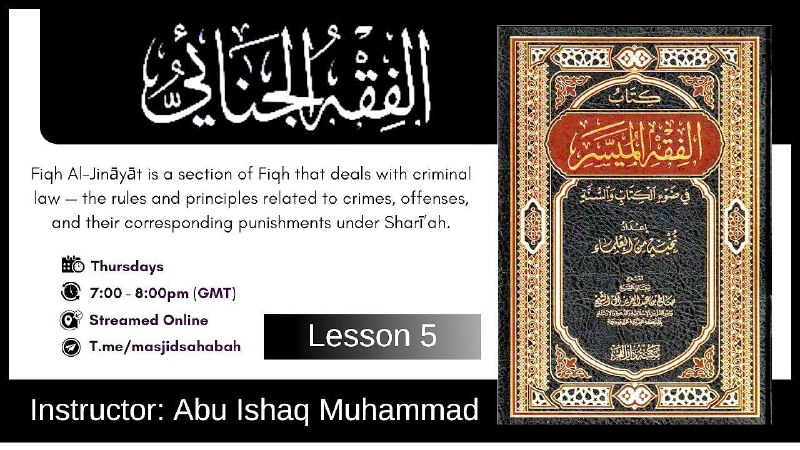
The Book of Crimes | كتاب الجنايات | Al-Fiqh Al-Muyassar
Lesson 5 ⤵️
https://youtu.be/0kzY1jT04bk
Al-Fiqh Al-Muyassar is a popular book in Fiqh, particularly for beginners and those seeking a simplified understanding of Halal and Haram. It aims to make complex legal rulings accessible and practical for everyday life.
Fiqh Al-Jināyāt is a section of Fiqh that deals with criminal law — the rules and principles related to crimes, offenses, and their corresponding…