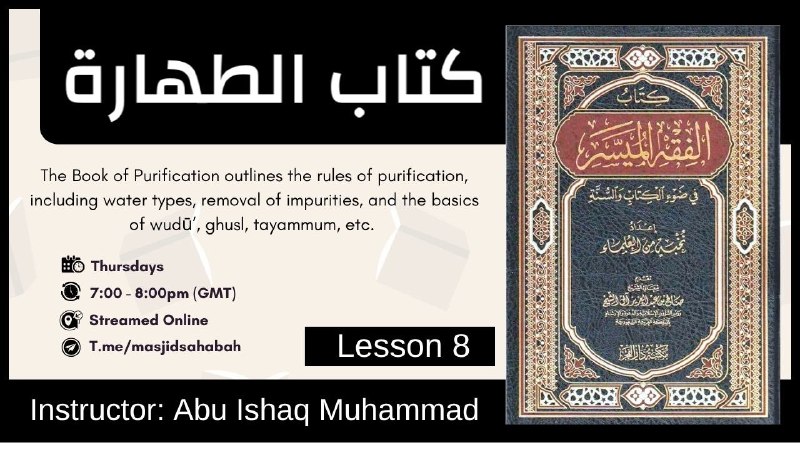
Fiqh Al-Muyassar
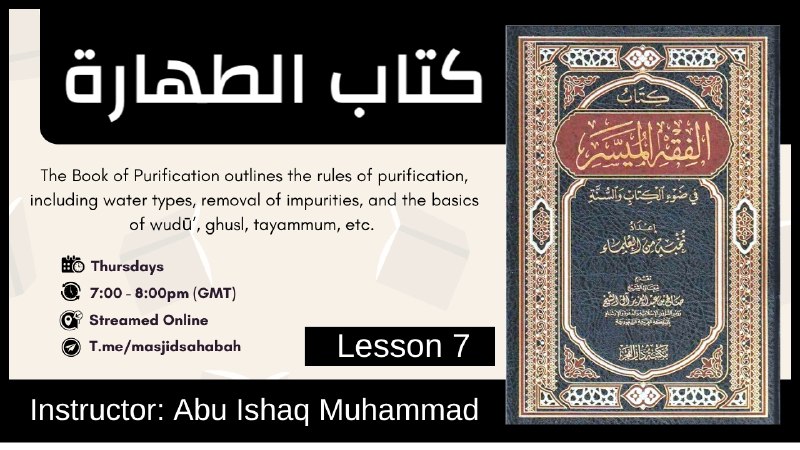
Kitāb At-Tahārah
Lesson 6
Summary:
We review the etiquettes of relieving oneself, outlining what is recommended, discouraged, and impermissible.
https://t.me/masjidsahabah/1736
LESSON 8 ⤵️
https://youtu.be/aubgFxVY4Yw
Summary:
We begin The Chapter of Ablution discussing the rules and etiquette of wudhu. This chapter explains what makes wudu obligatory, how to perform it step by step (washing the face, arms, wiping the head, and washing the feet), and the conditions for it to be valid. It also covers things that break wudu, recommended practices (like using a toothbrush or saying…
The Three Types of Friends
Sheikh Uthaymin rahimahullah said:
As for friends, they can be divided into three types:
1⃣. A friend of benefit:
This is someone who is your friend only as long as they gain something from you—whether money, status, or anything else. Once the benefit stops, they become like an enemy; they no longer know you, and you no longer know them.
2⃣. A friend of pleasure:
This person is only…
Fiqh Al-Muyassar
Kitāb At-Tahārah
Lesson 5
Lesson summary:
We cover the 'Chapter of Vessels' which outlines the rulings on utensils used for eating, drinking, and purification, explaining what is permissible and prohibited—such as the ban on using gold and silver vessels—while emphasising that utensils must be clean from impurities and that the default ruling is permissibility unless there is clear evidence…
Strength Comes Through Humility Before Allah
Sheikh Salih Aal Ash-Sheikh hafidhahullah said:
You become stronger through humility before Allah. Your strength comes from humility—not from saying “I” and “me.” No, your strength is in being humble.
Your strongest state is when you are humble, prostrating. A person is at their strongest, if one truly understands, when in prostration. This forehead, when it is on the…
LESSON 54 ⤵️
https://youtu.be/KxyhXYskLIU
Class Summary:
س. هَلْ هُنَاكَ نَعِيمٌ فِي الْقَبْرِ؟
Q: Is there enjoyment in the grave?
ج. نَعَمْ، فِي الْقَبْرِ نَعِيمٌ لِمَنْ يَسْتَحِقُهُ. وَالدَّلِيلُ: قَالَ النَّبِيُّ ﷺ: ((فَيُقَالُ: أَلْبِسُوهُ مِنَ الْجَنَّةِ، وَافْتَحُوا لَهُ بَابًا إِلَى الْجَنَّةِ)).
A: Yes, there is enjoyment in the grave for those who deserve it. The proof is that the Prophet ﷺ said: “It…
LESSON 47 ⤵️
https://youtu.be/2wuHE35Vc5U
Class Summary:
The student starts the fifth section of the book, where they read three lettered words, two of which are joined together.
Pdf: https://t.me/masjidsahabah/1110
LESSON 53 ⤵️
https://youtu.be/jQgwc1KXdXw
Class Summary:
س. هَلْ هُنَاكَ عَذَابٌ فِي الْقَبْرِ؟
Q: Is there punishment in the grave?
ج. نَعَمْ، فِي الْقَبْرِ عَذَابٌ لِمَنْ يَسْتَحِقُهُ. وَالدَّلِيلُ: قَالَ النَّبِيُّ ﷺ: ((عَذَابُ الْقَبْرِ حَقٌّ)).
A: Yes, there is punishment in the grave for those who deserve it. The proof is that the Prophet ﷺ said: “The punishment of the grave is real.”
Etiquettes of a student of knowledge
Lesson 1 ⤵️
https://youtu.be/cYdv2L5by80
Summary:
This lesson covers the following:
1. Virtues of knowledge
2. Ruling on seeking knowledge
3. Introduction to the book
4. Importance of good manners
5. Importance of correct methodology in seeking knowledge
6. Course overview
7. Section one of the book: Etiquettes of the Student with Himself [covers 15 Points]
LESSON 7 ⤵️
https://youtu.be/oaMCnZYkfqo
Summary:
The lesson covers the ten Sunan Al-Fitrah: trimming the moustache, letting the beard grow, using the siwāk, rinsing the nose with water, cutting the nails, washing the finger joints, removing underarm hair, shaving pubic hair, cleaning oneself with water after relieving oneself (istinja), and rinsing the mouth—showing that maintaining personal cleanliness is an…
LESSON 52 ⤵️
https://youtu.be/pUPh8hpb1gk
Class Summary:
س. مَا هُوَ أَوَّلُ مَنَازِلِ الْآخِرَةِ؟
Q: What is the first stage of the Hereafter?
ج. الْقَبْرُ أَوَّلُ مَنَازِلِ الْآخِرَةَ. وَالدَّلِيلُ: قَالَ النَّبِيُّ ﷺ: ((الْقَبْرُ أَوَّلُ مَنَازِلِ الْآخِرَةِ)).
A: The grave is the first stage of the Hereafter. The proof is that the Prophet ﷺ said: “The grave is the first stage of the Hereafter.”
Some companions began to strike him with sandals, palm branches, or garments.
Then one of them said: “May Allah curse him.”
The Prophet ﷺ said: “Do not curse him; do not assist Shayṭān against him.” He approved of the punishment but did not approve of cursing.
ʿUmar ibn Al-Khaṭṭāb (may Allah be pleased with him) dealt with Ṣabīgh ibn ʿAsl, who used to spread doubtful matters and ask problematic questions.
When news of him reached ʿUmar, he summoned him and confirmed his behaviour. Then…
Placing Sincere Advice in Its Proper Time and Context
Question
How should advice be given? And is it permissible to publicly expose (individuals) and to cause separation between the one being advised and his brothers?
Shaykh Muhammad Ba Jamal hafidhahullah
Advice is that the intention of the one giving it is truly to advise and to rectify the condition of the one being advised, and that he benefits from it. This varies from person to person.
Some people need advice…